Mobile App Development Guide 2026 | Build Future-Ready Apps
In today's hyper-connected world, our smartphones are more than just communication devices—they've become our digital companions. From waking us up in the morning to helping us track our fitness goals, order food, book cabs, learn new skills, and even run entire businesses, mobile apps have revolutionized how we live and work.
Mobile application development is the process that turns ideas into intuitive digital experiences. Every button you tap, every animation you enjoy, and every smooth interaction on your phone exists because of thoughtful design, powerful coding, and continuous innovation.
Whether you're a startup building your first app or an established brand scaling your digital presence, understanding the app development process is the first step to building something impactful.
What Exactly Is Mobile App Development?
Mobile app development is the process of designing, building, testing, and maintaining software applications for mobile devices such as smartphones and tablets. Today, businesses often look for solutions that go beyond basic mobile application development, focusing on performance, security, and scalability for long-term growth.
Apps can be of different types:
- Native Apps: Developed specifically for a single platform like Android (using Kotlin/Java) or iOS (using Swift/Objective-C). These apps are fast, reliable, and fully utilize the device's hardware and features—making them ideal for high-performance iOS mobile application development and platform-specific experiences.
- Hybrid Apps: Built using web technologies such as HTML, CSS, and JavaScript, and then wrapped in a native container. Popular frameworks like Flutter and React Native allow developers to build once and run across platforms—perfect for modern multi-platform mobile application development needs.
- Progressive Web Apps (PWAs): Lightweight, web-based applications that mimic the behavior of native apps while running directly in a browser.
In short, mobile app development is not just about coding—it's about creating user experiences that feel natural, personal, and engaging.
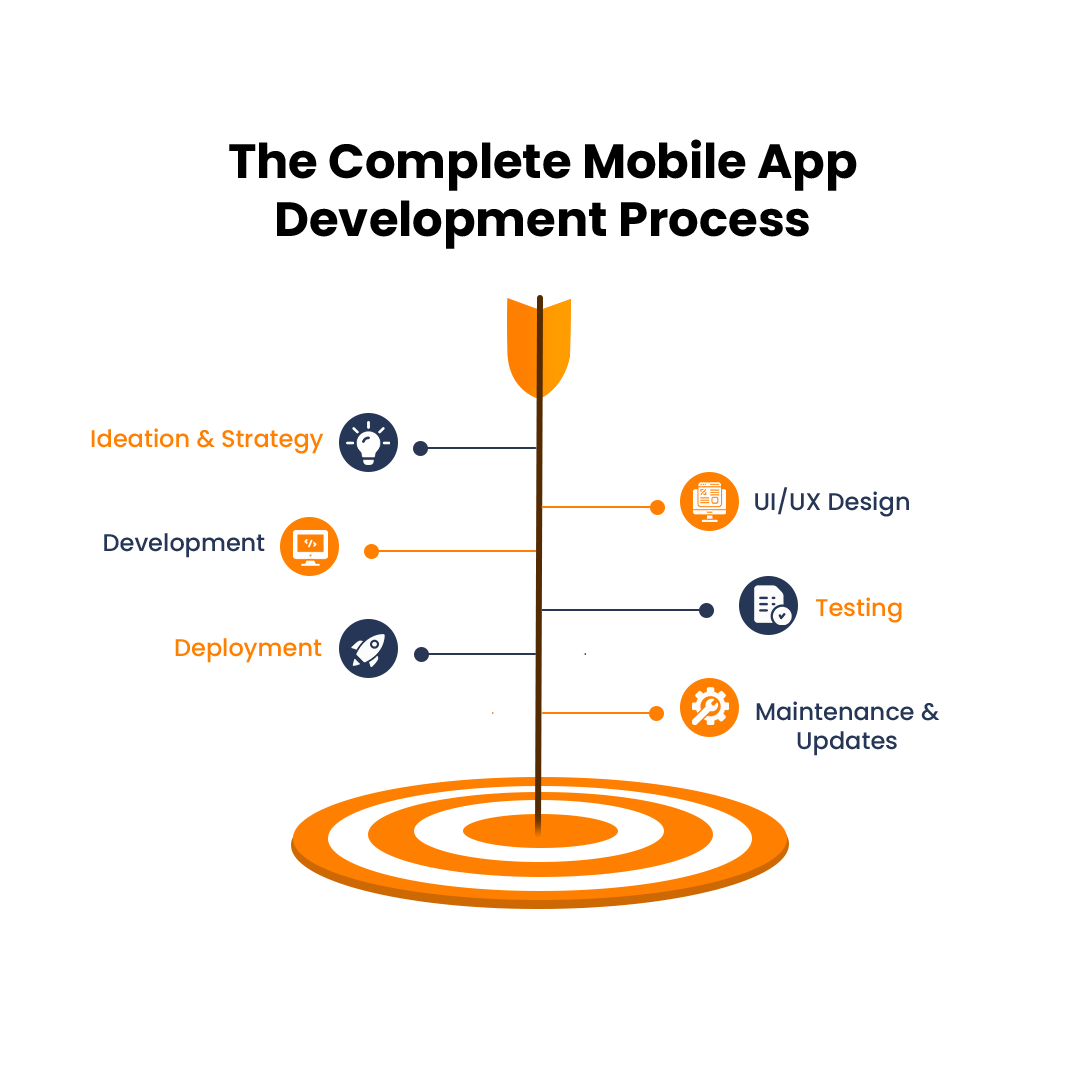
The Complete Mobile App Development Process
Building a successful mobile app requires both creativity and strategy. Let's explore the key stages that bring an idea to life—an approach trusted by modern custom software development companies and innovative digital teams worldwide.
1. Ideation & Strategy
Every great app starts with an idea. At this stage, developers and business strategists define the purpose of the app—what problem it solves, who it serves, and what value it offers. Market research, competitor analysis, and insights from information technology consulting firms help shape a clear development roadmap.
2. UI/UX Design
The app's design defines its success. The User Interface (UI) decides how it looks, while the User Experience (UX) determines how it feels. Designers create wireframes, prototypes, and visual layouts that ensure users enjoy a seamless and intuitive experience—making design as important as code.
3. Development (Coding)
Once the design is finalized, developers begin building the backend (server, database, APIs) and the frontend (user interface). Choosing the right framework—Flutter, React Native, Swift, or Kotlin—is crucial for stability and performance. This is where experienced IT service provider companies stand out with robust coding practices and scalable architectures, especially those offering custom software development services that ensure reliability and scalability.
4. Testing
Before launching, every element of the app is tested for performance, security, usability, and compatibility. Comprehensive testing helps eliminate bugs and ensures the app runs smoothly across devices and operating systems.
5. Deployment
After testing, the app is submitted to platforms like the Google Play Store and Apple App Store for review and approval. Once approved, users can download and start using it immediately.
6. Maintenance & Updates
The process doesn't end at launch. Regular updates, feature enhancements, security patches, and performance improvements keep the app relevant, user-friendly, and competitive in the market.
At ByteBillion, we approach development with a long-term mindset—focusing not just on launch but on growth, scalability, and innovation.
ByteBillion Headquarters - Indore, India
Emerging Trends in Mobile App Development for 2026
The mobile app industry evolves rapidly, driven by technological advancements and changing user expectations. Here are the key trends shaping the future:
- Cross-Platform Development – Tools like Flutter and React Native help build apps faster and cost-effectively for multiple platforms.
- Data Privacy & Security – With growing cyber threats, strong encryption, biometric authentication, and GDPR compliance are non-negotiable.
- AR & VR Experiences – Augmented and Virtual Reality are enhancing gaming, education, shopping, and real estate experiences.
- Voice and Gesture Control – Hands-free operations through voice assistants like Siri, Alexa, and Google Assistant.
- 5G-Powered Apps – Ultra-fast internet speeds enable seamless streaming, real-time gaming, and advanced IoT integrations.
These trends are not just futuristic—they're reshaping how users interact with apps right now.
Why Businesses Should Invest in Mobile Apps
A professionally developed app is one of the most powerful assets a business can have. Here's what it can bring to your brand:
- Enhanced Customer Loyalty: Personalized communication and rewards encourage repeat engagement.
- Improved Sales & Revenue: Mobile commerce and in-app purchases significantly boost earnings.
- Brand Differentiation: A sleek, innovative app makes your business stand out in competitive markets.
- Streamlined Operations: Internal apps improve efficiency, communication, and task management.
- Real-Time Feedback: Users can share feedback instantly, helping businesses adapt and improve.
Simply put, if your business isn't mobile-ready, you're missing the fastest-growing channel for engagement and growth.
ByteBillion's Approach to Mobile App Development
At ByteBillion, we don't just build apps—we build digital experiences that align with your brand's vision and user needs.
Our process focuses on:
- Deep user research to understand real-world problems.
- Clean, intuitive UI/UX design that enhances usability.
- Agile development for faster delivery and adaptability.
- Continuous testing and optimization for long-term success.
- Transparent communication throughout the project.
We believe an app should not only look great but also perform flawlessly and scale effortlessly. That's why our team of creative designers, skilled developers, and strategic thinkers works hand-in-hand to deliver results that matter.
Final Thoughts
Mobile app development is more than a trend—it's the foundation of digital innovation. As technology continues to evolve, businesses that adopt mobile-first strategies will lead the way in the future of digital engagement. Whether you want to build an on-demand app, an e-commerce platform, or a custom enterprise solution, now is the perfect time to invest in a strong mobile presence with modern mobile application development capabilities.
At ByteBillion, we transform your vision into powerful mobile solutions that users love and businesses grow from.